
Companies throughout the UAE are using mobile technology as a way to accommodate the evolving expectations of their customers. So, developing a mobile app has become a weapon in the strategic arsenal of businesses that aim at enhancing their relationship with customers, cutting down on unnecessary steps in their business processes and paving the way for sustained growth. In fact, regardless of which sector your business belongs to – be it retail, healthcare, logistics or real estate, app creation has become a necessary investment.
But, writing code for an app is only a small part of the process of creating a successful app. You also need planning, a design that puts users first, testing, and continuous changes after the app goes live.
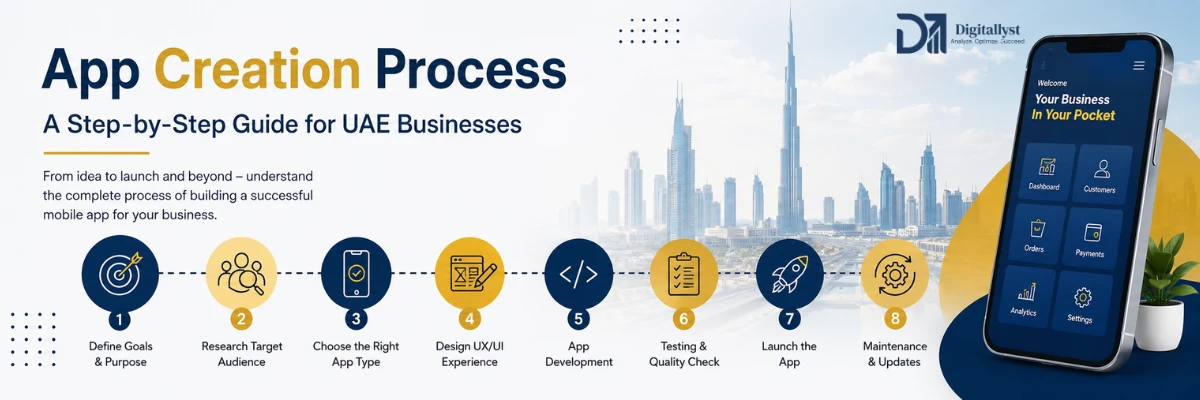
This article shows steps of app creation for companies in the UAE. By understanding each stage, you can make informed decisions and build an application that supports your long-term business goals.
Why UAE Businesses Are Investing in Mobile Apps
The United Arab Emirates has one of the world’s highest rates of smartphone adoption. Customers have started demanding businesses to provide them with quick, easy, and digital priority services. Because of this, mobile apps have proven to be very effective tools for companies of all sizes.
A well-developed mobile application can help businesses:
- Improve customer engagement
- Offer faster customer support
- Increase online sales and bookings
- Build stronger customer loyalty
- Automate everyday business operations
In addition, a mobile app offers direct interaction between businesses and customers via notifications, customized offers, and quick navigation from the service menu.
Step 1: Defining Business Goals and the App’s Purpose
Understanding your reasons for needing a mobile app is the very first move in the app creation process.
Start by asking questions such as:
- What problem will the app solve?
- Who will use the application?
- What business objectives should it achieve?
The restaurant business wants to order food online through their apps, whereas the hospital would like to offer its patient online booking. The delivery company may, for example, use the shipment tracking functionality of the app.
When your goals are clear from the beginning, every development decision becomes more focused and effective.
Step 2: Researching the Target Audience
You have to know what your users want from an application before making it.
On top of demographics, buying preferences, favorite devices, and pain points, research needs to identify which aspects of the service or features are most valued by consumers.
Also, studying the features of rival apps offers useful hints. Rather than replicating what they’ve done, look to see where they’ve excelled, and figure out how your app can give users a more fulfilling experience.
The insights from these sources enable a development team to create an app that matches customer needs with a high degree of accuracy.
Step 3: Choosing the Right Type of Mobile App
The choice of development platform will hinge on what you are aiming for as a business, how much you are willing to spend, and who your ideal customers are.
Native Apps
The Native app can be tailored for each Android and iOS separately which is good for performance and user experience since they fully leverage the hardware and the features in these environments.
Cross-Platform Apps
With a cross platform approach a product development team can create an app that can run on both platforms and that is the reason why this method could cut the time required for coding and ease subsequent upgrades.
Progressive Web Apps (PWAs)
A company that desires to have a mobile presence without the inconvenience of App downloads and installations in the classic sense may find a Progressive Web App (PWA) as a viable solution.
Going for the right app type at the very first stage will result in minimizing both development costs and the expenses of subsequent maintenance.
Step 4: Designing the User Experience (UX) and User Interface (UI)
A great-looking design is just one part of the equation. What a user really wants is an application that performs well, it is clean, efficient and effortless to work with.
A strong UX design focuses on:
- Clear navigation
- Fast loading screens
- Simple user journeys
- Easy access to important features
UI is a vehicle of your brand personality by displaying the same colour fonts, icons, and layout every time.
A well-designed application encourages users to stay engaged and return more frequently.
Step 5: App Development Begins
Once the design has been agreed, the team moves to the phase of development.
Frontend engineers are working on the part users can see and click on to, backend developers are responsible for developing the tools that handle data, authentication, and business logic.
Many applications also require third-party integrations, including:
- Secure payment gateways
- Maps and location services
- Customer relationship management (CRM) systems
- Push notification services
- Analytics tools
Throughout development, developers typically build and review features in stages. This approach makes it easier to identify issues early and maintain project quality.
Step 6: Testing the App Before Launch
Testing is really an essential stage in the overall app creation cycle.
Bugs even of minimal size are capable of negatively influencing customer satisfaction and app ratings.
Thorough testing should cover these aspects:
Functional Testing
Every feature should perform exactly as intended without errors.
Performance and Security Testing
The application should load quickly, remain stable during heavy usage, and protect customer information from security threats.
Device Compatibility Testing
The app should function consistently across different Android devices, iPhones, and screen sizes to provide a reliable experience for all users.
Fixing problems early on helps companies avoid costly maintenance issues later and enhance user trust.
Step 7: Launching the App
Once testing is done and passed, the application is ready for distribution.
Businesses publish their mobile apps first onto the Google Play Store and then onto the Apple App Store after satisfying each store’s requirement for app submissions.
Getting the app up is not the end though – the real success is launching by marketing the app online with digital marketing, social media, email campaigns, and communication with customers.
By getting feedback from early users, businesses can discover where improvements are needed and react rapidly at meeting the desires of their customers.
Step 8: Maintaining and Improving the App
The process of app creation lasts even after launching it.
Regular maintenance keeps the application secure, compatible with new operating system updates, and free from technical issues.
Businesses should continuously monitor:
- User engagement
- App performance
- Crash reports
- Customer feedback
Developers can then use this data to optimize the applications by updating, fixing bugs, adding new features to the current version, because of this making the usability of the application much better.
Through continuous improvements all brands can stay on top of the UAE digital market.
Common Mistakes to Avoid During the App Creation Process
Many businesses face delays or increased costs because they overlook important planning stages.
Some common mistakes include:
- Starting development without clear business objectives
- Ignoring customer research
- Choosing unnecessary features over usability
- Skipping comprehensive testing
- Delaying security updates and ongoing maintenance
Avoiding these mistakes increases the likelihood of building a successful and scalable mobile application.
Final Thoughts
Successful app creation is more than just building a good-looking app. UAE companies that spend time on goal setting, user analysis, choosing the right development method, thorough testing, and post-launch app support should win a loyal customer following and a steady revenue growth. It is through a clear, well-designed development cycle that businesses can build applications that not only stay relevant but are also safe and keep up with the current trends in the digital marketplace.
Ready to Build Your Mobile App?
Thinking of building a mobile application for your business? Digitallyst UAE gives comprehensive end-to-end mobile application development solutions aligned to your end goal. We understand that significant thinking and planning go into delivering maximum value to mobile users, and then build the app. We will work with your business to deliver ideas and mobile apps that are scalable, efficient, flexible, responsive and cost-effective for the long run. When launching your new start-up or digitising an existing business, contact us today!