
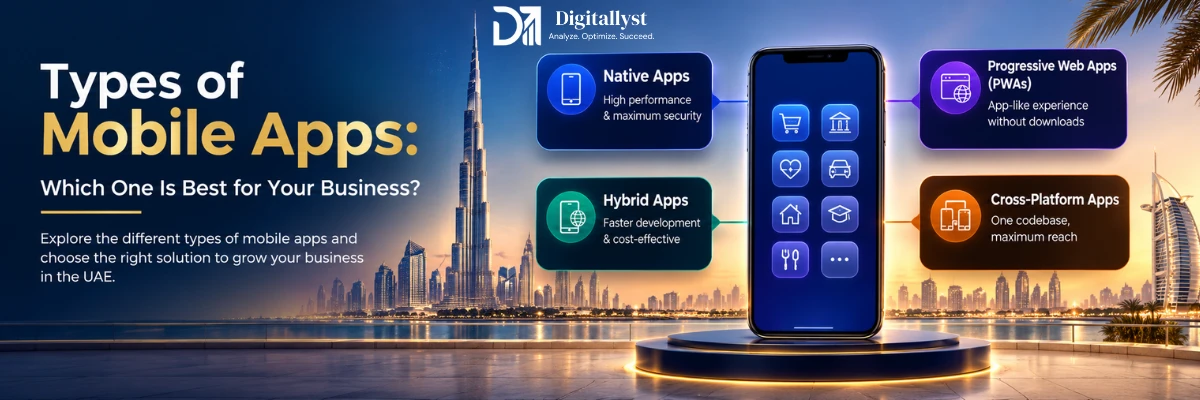
Mobile apps are nowadays an integral way for businesses to communicate with customers. In the UAE, known as one of the top regions for smartphone penetration worldwide, mobile app development is one of the must-have features for businesses to increase customer satisfaction, grow profits, and optimize processes at the same time.
Though, before diving into development, it is important for companies to first learn about the various types of mobile apps that are out there. Each application type has its own characteristics including different levels of development costs, features, and performance capabilities. The choice of the appropriate development model can greatly help with saving time, minimizing costs, and helping to achieve your company’s goals for the future.
This guide explains the most common types of mobile apps and helps you determine which one best suits your business goals.
What Are Mobile Apps?
Mobile apps are a software meant to work with mobile phones. Mobile apps are great tools that businesses use to sell their products, provide services, talk to their customers, and make improvements in operational areas.
Retail, healthcare, education, finance, food delivery, hospitality, and real estate are some of the top sectors that are using mobile applications nowadays to remain on a competitive edge. With the continuous implementation of technology in UAE, having a top quality mobile app has turned from just an attractive feature into an indispensable asset, which is considered worth investing in.
Types of Mobile Apps
Learning about various types of mobile apps supports companies in making wise choices based on what they have for finance, whom they want to reach (potential or existing customers?) and the technology available (how sophisticated their devices are, for instance).
Native Mobile Apps
Definition
Native apps are tailor-made applications which work on one Operating System, say Android or iOS. These platforms have different coding languages which include Kotlin for Android development, Swift for iOS.
Advantages
- Excellent speed and performance
- Smooth user experience
- Full access to device features such as GPS, camera, and biometrics
- High security and reliability
Limitations
- Higher development and maintenance costs
- Separate apps are required for Android and iOS
Best For
Businesses that require advanced functionality, maximum performance, or high security, such as banking, healthcare, logistics, and gaming applications.
Hybrid Mobile Apps
Definition
Hybrid mobile apps combine web technologies with native app capabilities. They use a single codebase that works across multiple platforms.
Advantages
- Lower development cost
- Faster time to market
- Easier maintenance with one codebase
- Supports both Android and iOS
Limitations
- Performance is lower than native apps
- Limited access to some advanced device features
Best For
For companies, startups or small businesses with budget constraints and time to market, hybrid apps are the cheapest way to release and maintain the product on different Operating Systems. This also includes businesses who need a Minimum Viable Product (MVP) or service-based app to kick start their operations in the market.
Progressive Web Apps (PWAs)
Definition
Progressive Web Apps (PWAs) are web applications that resemble a native app and offer a near-native experience when accessed from mobile browsers.
Advantages
- Lower development investment
- Works on multiple devices
- Fast loading speed
- No app store approval process
- Can support offline functionality
Limitations
- Limited access to some smartphone features
- Lower performance than native applications
- User experience depends on browser capabilities
Best For
Such a technology is mainly attractive to businesses that are driven by creating the content, gathering leads, providing booking systems, running online services, or operating information websites.
Cross-Platform Mobile Apps
Definition
Cross-platform mobile apps can be developed with the help of systems like Flutter or React Native, to develop one app for Android and iOS.
Advantages
- One codebase for multiple platforms
- Reduced development cost
- Faster deployment
- Consistent user experience across devices
- Easier updates and maintenance
Limitations
- May not achieve the same performance as fully native apps for highly complex applications
- Some platform-specific features require additional customization
Best For
Growing businesses, E-commerce companies, SME’s are organizations that want to communicate and provide and receive information to and from Android and IOS users without any compromise with development efficiency.
Comparison of Different Types of Mobile AppsWhich Type of Mobile App Is Best for Your Business?
| App Type | Performance | Development Cost | Time to Build | Best For |
|---|---|---|---|---|
| Native Apps | Excellent | High | Longer | Enterprise businesses, banking, gaming, and feature-rich applications |
| Hybrid Apps | Good | Moderate | Faster | Startups, service businesses, and MVP development |
| Progressive Web Apps (PWAs) | Moderate | Low | Fastest | Content-driven websites, online services, and lead generation |
| Cross-Platform Apps | Very Good | Moderate | Fast | SMEs, e-commerce businesses, and companies targeting both Android and iOS |
Which Type of Mobile App Is Best for Your Business?
We can’t give you a definite answer as this is very much a matter of your aims.
A lot of young companies find a hybrid app or a cross-platform app to be great options since they reduce the development budget and they bring the product to the market much quicker. What this essentially means is that you can see which way the product is going to be accepted in the market before the company makes the big bucks.
For the purpose of a smoother retail experience, payment gateway integration safety, and tailored buyer relationships, mobile retailers usually opt for cross-platform or native application software.
So the choice of type of mobile app you want completely depends on your business goals & requirements
Factors to Consider Before Choosing Among Different Types of Mobile Apps
Before selecting a development approach, evaluate the following factors:
- Your available development budget
- Business objectives and long-term growth plans
- Target audience and preferred devices
- Required features and functionality
- Development timeline
- Future maintenance and updates
- Scalability requirements
- Integration with existing business systems
Considering these factors early helps avoid unnecessary redevelopment and ensures your application remains effective as your business grows.
Why Choose Digitallyst for Mobile App Development in the UAE
We work with businesses that want to determine the right mobile app solution as their objectives, industry, and financial limits. Our staff at Digitallyst creates robust and high-performing apps, always keeping user experience design and increasing business growth at the forefront of their minds.
We provide app development services starting from idea conception & UI/UX design to coding, debugging, launching, and providing continued support. In this way, we are able to develop apps for a mobile audience in the competitive environment of the UAE that are really going to hit the spot.
Final Thoughts
It all starts with a proper understanding of different types of mobile apps when making a decision on building a digital product. Native hybrid progressive web apps, and cross-platform solutions each provide unique advantages given your business needs.
Instead of following the crowd that picks the most popular one, go for what really suits you well – what you want to achieve, what you can afford as well as your future development. When a mobile app strategy is well-conceived, your customers’ interaction increases and you make preparations for long-term business success in UAE’s fast-changing digital world.